Too much friction.
Smartphones have powerful accessibility features, but camera positioning, deep menus, and unfamiliar gestures can still create friction in some everyday situations.
ONE / INVESTOR OVERVIEW / CONCEPT STAGE
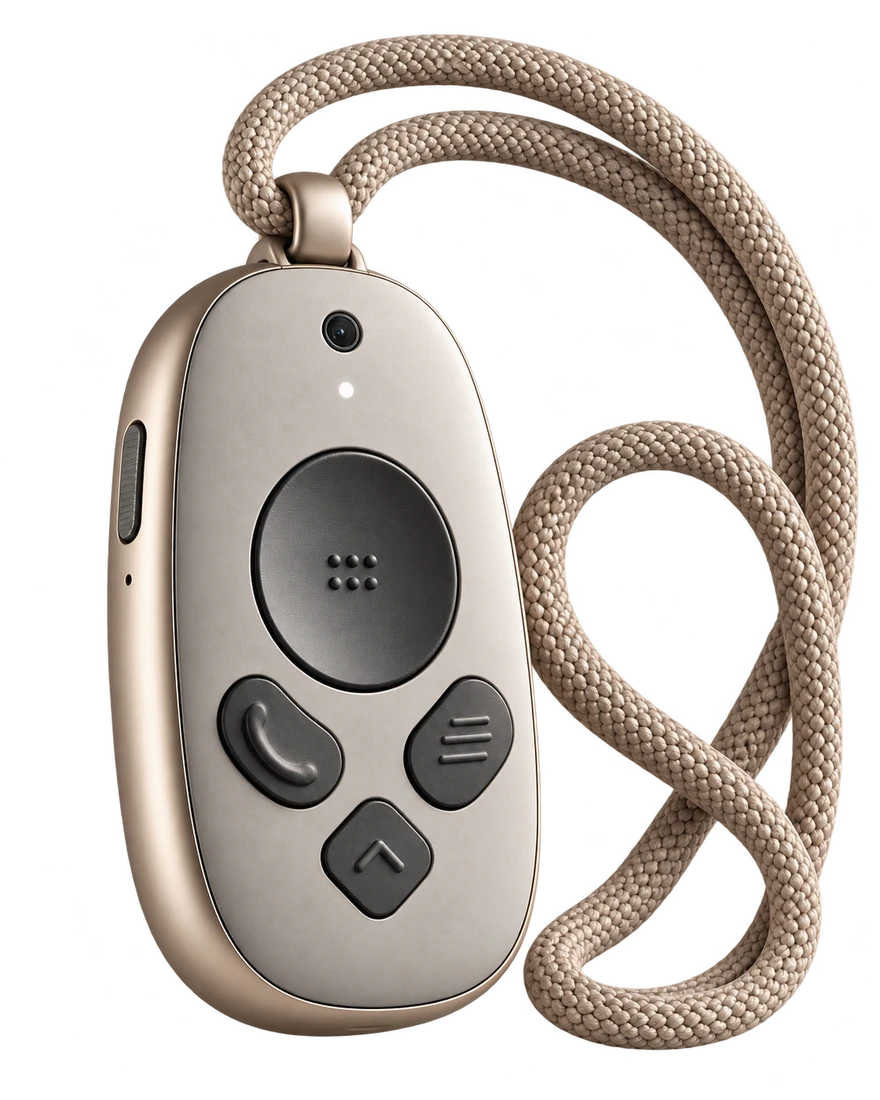
ONE is a proposed tactile, voice-first wearable designed around the daily experiences of blind and low-vision people. We're developing the foundation for a product where thoughtful accessibility meets premium consumer design.
THE THESIS
Smartphones have powerful accessibility features, but camera positioning, deep menus, and unfamiliar gestures can still create friction in some everyday situations.
An immediately recognizable tactile layout, a natural conversation model, and a wearable form factor designed to be within reach.
Start with user co-design and an Android-linked prototype; measure real-world usefulness before committing to proprietary cellular hardware.
THE LANDSCAPE
Blind and low-vision people already have capable tools. ONE is not claiming to replace them; the hypothesis is that a dedicated, tactile, wearable interface can reduce friction in specific everyday moments. This is a hypothesis to test with users, not a proven advantage.
Screen readers and camera-based reading apps are powerful and free to the user. ONE's question: can a worn, always-reachable interface be faster for quick tasks?
Head-mounted devices offer hands-free vision assistance. ONE explores a chest-worn, button-first alternative with a lower social and sensory footprint.
Purpose-built readers and navigation aids exist, often at high prices. ONE would need to prove a clear reason to carry or wear another device.
Orientation and mobility training, sighted-assistance services, and peer communities remain essential. ONE is intended to complement them, not substitute for them.
PRODUCT ARCHITECTURE
The proposed MVP keeps interaction simple and leverages existing smartphone hardware to reduce engineering risk. Advanced visual features would use consent-based cloud AI when necessary.
WHAT MUST BE PROVEN
These are the questions an engineering and investment program needs to answer—not details we pretend are already solved.
Do blind users find the controls, voice workflow, and chest-worn form genuinely better than alternatives?
Can the proposed enclosure, battery, camera, connectivity, and thermal targets coexist comfortably?
Does the elastic cord retain its properties, and does the breakaway clasp release appropriately under risk?
Can users understand and control capture, cloud processing, and communication failure modes?
What can be protected after prior-art research and professional patent counsel review?
What price, service model, distribution channels, and ongoing AI costs are sustainable?
PROPOSED DEVELOPMENT PLAN
A staged process designed to reduce risk before scaling hardware investment.
CAPITAL WOULD SUPPORT
Funding priorities would include accessible research with compensated participants, industrial and electronic engineering, software development, safety testing, specialist legal advice, and a measurable pilot.
Specific raise size, valuation, unit economics, patent status, and delivery timing will need substantiated plans before being offered as investment terms.
This page is a concept overview, not an offer to sell securities or a representation that the product has been patented, certified, manufactured, or tested.
MILESTONES AND USE OF FUNDS
Each stage ends with a decision gate. Budgets and dates will be added once they are costed with engineering and research partners; none are implied here.
Co-design sessions and tactile studies with compensated blind and low-vision participants. Pass criterion: clear preference for the control layout and workflow.
Android-linked demonstration of calling, reading and scene description. Pass criterion: reliable results in realistic everyday conditions.
Integrated wearable prototype, privacy mechanisms and breakaway cord testing. Pass criterion: comfortable, safe, and understandable to wear.
Paid participant pilot. Pass criterion: measurable benefit over participants' current tools, and a sustainable service cost.
Patent counsel, safety and regulatory review, and manufacturing partner selection before any hardware scale-up.
Participant compensation and research, engineering, software, safety testing, legal and IP advice, and pilot operations. Allocation percentages to follow a costed plan.
THE NEXT CONVERSATION
We're preparing ONE for conversations with accessibility experts, engineers, manufacturing partners, and potential investors. The first step is understanding what needs to be proven.
Project contact details and a formal investment deck can be added once confirmed.